Tom Darling: the DM that became a Sergio Tacchini partnership
An award-winning franchise owner with three stores and a decade behind the chair — and no way to be known beyond his own postcode. Two weeks in, a heritage Italian fashion house messaged him first. Tom talks through the ego of being fully booked at twenty, the lease that fell through, the health break that took him off the Delhi stage, and the part he says I got wrong.
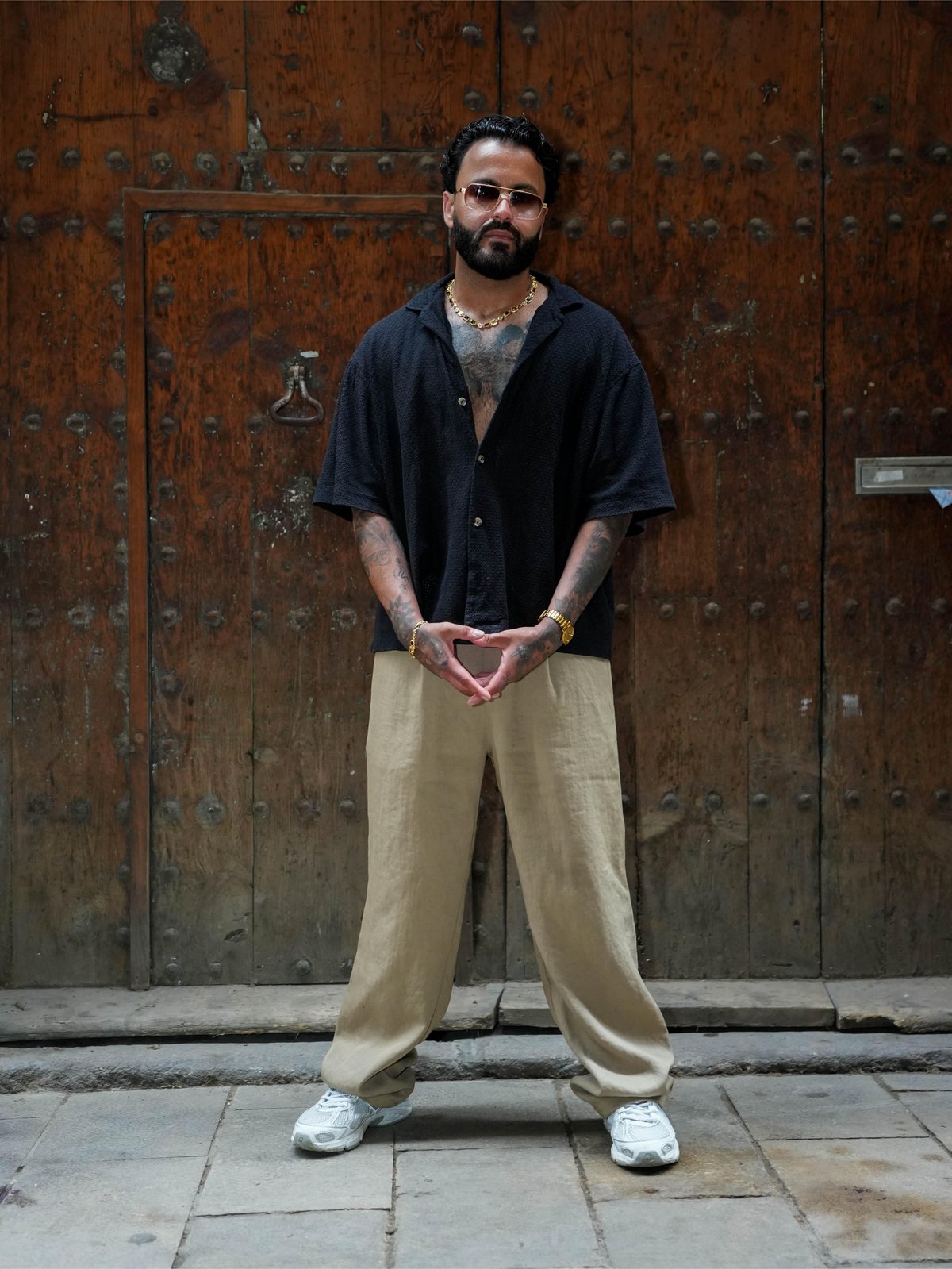
Lightly edited for readability from the spoken original; names and brand terms corrected. Tom raised his health break himself on camera and asked for it to stay in — it is published here in his own words, unembellished.
JJ: Every barber I've met has been told the same thing. Get good, get busy, fill your columns — and when your column's full, congratulations, you've made it. Today I'm introducing you to Tom Darling. In the last few months he's gone from a busy shop owner with multiple branches to a collaboration with Sergio Tacchini and his first international show. Tom — who are you, and where did it start?
Tom: Tom Darling, Darlin's Barbers. Started cutting hair nine, ten years ago now — started in hairdressing. I was in year nine, working Saturdays in a small salon just down the road from here. They offered me the chance to start properly and I thought, why not. Back then it was a bit different — it wasn't the cool thing to do, it wasn't a trend.
JJ: Did you fall into it, or was it always the plan?
Tom: Fell into it by chance. But being in the industry, I thought — this looks like good crack.
JJ: What did you want to do growing up?
Tom: Music, or be on stage. So this is almost doing that, with a different passion. It's putting on a show in a different way.
The fully booked ceiling
JJ: We both worked for the same brand before — you were at the Northampton branch. What was it like being fully booked at twenty?
Tom: It was a thrill, and it felt good. But a lot of ego came with it. I had a massive ego back then.
JJ: I remember walking past at eleven, twelve at night with family and you'd still be trimming.
Tom: I was. Christmas Eve, New Year's Eve — I'd be there. I'd see people walking past done with their night out and I'd still be going. A different level of hunger got me there; it doesn't just come.
JJ: Nothing about how you started was special. It's the hunger.
Tom: I was the worst barber in that shop when I joined. By a mile. But that gives you the hunger to push on and be the best.
JJ: When did you realise a fully booked column was as far as that road went?
Tom: Covid gave me the chance to see what I was actually bringing in — and what spin I put on it. When you're on your own in your own room, nobody's putting their ideology on you. It's your own thing. I created something very different on my own, and I thought: for ten per cent of the price, why not move on and rent a chair somewhere else?
JJ: How was that transition? A lot of stylists want to make that jump and worry about losing clients.
Tom: That's when I realised — if you take a jump you won't have the same support, you'll have a different support group. And it's strangers. People from that shop who've seen your work and think, this is great, I'll follow him. Every shop has its own community, and that community ends up supporting you. That principle goes for any risk you take. You might not get your family supporting you. You might not get your best mate. You will get strangers — you have to have strangers supporting you.
JJ: You rented a chair six to eight months. What was the ceiling that time?
Tom: What you're earning is great — but there are only so many hours in a day. Being behind the chair all day, every day, posting from behind the chair — it's great for gaining and retaining clients. But I wanted more than that. Positioning. You're only attracting new clients, which is fine if that's the goal. I wanted to build something bigger.
JJ: That's the part the industry doesn't tell you. I don't know anyone who got into a creative industry and said their end goal was to be a fully booked stylist and nothing else.
Tom: It's a short-term goal. Chase being the best and the clients will come. If you chase clients, it doesn't come.
The shop that fell through
JJ: You signed heads of terms on a shop in 2021 that didn't happen. What went wrong?
Tom: We were very inexperienced. Our bargaining was shocking. We went in saying "this is great, this is great" — because it was a lovely space. But the business world doesn't work like that. You can't be that nice. They were taking things away from us each week, because we were so obviously up for taking it. Eventually we realised we weren't getting a good deal at all.
JJ: What advice would you give someone signing their first lease?
Tom: Pick what is wrong with the building before you tell them what's right with it. Pick it apart, and get the best deal out of it.
Owning it
JJ: You opened the town centre shop in November 2024, then the Foundry in January. What did you think having your own shop would fix?
Tom: Honestly, I'd been thinking about quitting — about stopping cutting hair. I was reaching ceilings with no more ceilings to climb. Which was actually my brain limiting it. Opening made so much sense and gave me that drive again. I'd had the business plan for years; it was just time to put it into action.
JJ: What changed when you went from employee to owner?
Tom: Everything. It's your baby, and nobody else will treat it the same. All the times I was nagged at — changing the bin, the mundane jobs — I get it now. Those one per cents all add up. Every job is yours: marketing, cleaning, accounts, admin. It's five jobs in one.
Why he reached out
JJ: You were already a successful business owner. Where was your head at when you got in touch?
Tom: I'm very hard on myself. I looked at my stuff and thought: this isn't enough. To some people it might look like a lot. To me it wasn't. The style of videos, who I was targeting — not enough. I reached out and said, I need to get in these rooms. I'd even pay you. I didn't know you had a programme. You said, brilliant, I've got exactly that.
JJ: There's a point where technical cutting courses aren't the gap any more. Nothing wrong with them — I still go on them. But there has to be something that helps you scale.
Two weeks
JJ: We started the first week of February. You set the record in four years of me mentoring — first brand partnership in two weeks. With a brand you support like a football club.
Tom: That's exactly how strongly I feel about it, yeah.
JJ: What were the doubts when I gave you the process?
Tom: You open the door, but I have to walk through it. I knew what I was capable of. Self-confidence, a bit of delusion mixed in. I didn't think Sergio were going to get in touch — I thought someone would. A couple of local shops did. Then something much bigger came.
JJ: And that was within three or four days of finishing the images — which weren't even edited.
Tom: Unedited. There were about 190 pictures in the collection and I sent them eight of the best. They were so happy they followed me. I thought, cool, that's really cool. Then I checked my messages and it said they'd really like to collaborate and work with me in future. We took that meeting straight away. They gave me a shop for the new collection, showed me the lookbooks, the CAD drawings of the clothes, all pre-release.
JJ: What made you commit in the first place? I usually know within twenty minutes of a call whether someone will.
Tom: The proof's in the pudding. If you're buying something you have to see the person doing very well in that field before you enter it. You'd travelled the world, cut some huge names — especially the cricketers, which I'm jealous of.
JJ: I don't even follow cricket. I was calling you asking who this person was.
Tom: [laughs] And where you and I came from — we were both a bit underdogs. That was relatable. Any product you buy has to be relatable.
JJ: What did you give up to say yes? I want people to understand the sacrifice.
Tom: It was either that or going solely on the Foundry spot — we had a private investor. I put aside half of what was going into that, and half of what came back, to fund the programme.
What he now teaches his own team
Tom: Phase one is content strategy — I've done the audits, gone through their Instagram, making it stronger and hitting a larger market. Phase two is targeting the brands they want. Phase three is targeting the people they want — footballers, that sort of thing. Phase four is building their personal brand, which links to all of it.
They can pick which parts they want. Some don't want the stage work, some don't want fashion week, some don't want brand work — but they've got the option. That opens more doors, because I can't be the only one smashing that side of it. If I'm not behind the chair all the time, I have to give them that route too.
The show he didn't make
JJ: Where were you when you got the call for Professional Beauty India, Delhi?
Tom: I was in hospital.
JJ: Are we okay to talk about this?
Tom: Yeah. It was a proud moment — I don't think it matters where you are in the world. I did all I could to get back to health to be at the show, but it didn't align and I couldn't make it.
JJ: Who did you tell first?
Tom: My dad. There were a few questions about why the Indian market. But we've got a plan, and I really like that side of it. It was a proud moment.
JJ: People have been asking where you've been. What was going on?
Tom: A lot behind the scenes — physically, and mentally as well. I had to take a break. It wasn't a choice.
JJ: What was the hardest part?
Tom: Not being at the wheel. Decisions being made out of my control. Not performing on the show, not looking after the shop, not directing the lads. And even before that it was like that anyway — an internal war nobody really knew about.
JJ: You went quiet on me for a month. I found out later from someone else. What did you think I'd say when you came back?
Tom: I was confident our relationship was stronger than that. But there's a limited number of spaces, and you have to earn that space — it's a privilege, not a right. I'd put a lot in beforehand. There was still a worry. I lost a lot of people during that time.
JJ: I'm not the sort to cut someone off. I chase you up once, twice — then once I found out what was going on, I left you to it. There were still contracts running in the background and I managed those on your behalf, smoothing things out, because I knew you'd come back stronger.
Coming back
JJ: Your first job back was the Fairmont — leading a team of barbers at Fairmont Windsor Park for one of the most affluent families in Dubai, the Apparel Group.
Tom: A special three days. The setting, the level of client, and the service. I hadn't done a hot towel shave in about nine years — I'm implementing that back in the shop now. It was a learning day, and I'm strong on that: you can't learn too much.
JJ: And now Mumbai — headlining at the end of August.
Tom: Yes.
The franchise
JJ: Talk about what's next for DB.
Tom: We're transitioning a lot of online work — modules, coaching, training — but mainly the franchise model, rolling out in about two to three weeks. The UK industry is at 1.4 billion right now and heading to 2.1 by 2030. The interesting part is self-employment status: currently around 63%, moving toward 90% by 2030. That's exactly how our model runs.
We walk you through from the first phone call to signing the lease, project-manage the build to your budget, then help you gain staff and retain them while building the systems that create income for them. There's a manual that takes you week by week through the first two years, and 24/7 access to me — I'll come and visit, train the lads, do seminars. I genuinely believe there can be a Darlin's in every town, and not just in the UK.
Advice
JJ: Someone watching this is fully booked, a few years in, wondering if that's all they're meant to be. What do you tell them?
Tom: Tell yourself that's nonsense. Open your mind. Get in touch with one of us and we'll show you different doors, different routes. Do something different, be yourself, and people will come to you — and I don't mean your everyday client. I mean people with influence.
JJ: A famous DJ came to you — you didn't reach out to him.
Tom: No, he hit me up. That's a privilege. Great guy — we made content, spent good time in Manchester. It was great to meet someone travelling the world doing the same as me in a different way.
JJ: Transferable skills. Networking. If you hang around with six successful people you'll be the seventh — but to attract them you have to position yourself differently.
Tom: And be willing to do the work, because it isn't given to you. It's only guidance.
JJ: If you restarted at 21, what would you do differently?
Tom: Nothing. I've learnt more from failing than from winning.
JJ: Always be the smallest fish in the room.
Tom: Don't be the best in your shop, either. And keep an eye out for Darlin's — it's coming to a town near you.
What this episode covers
Tom Darling already had a great deal before he ever spoke to me. Darlin's Barbers is award-winning, franchised to three stores inside a year, and he had over a decade behind the chair. What he did not have was a way to be known beyond his own postcode — or a way to be taken seriously by the brands he had followed for years.
The Sergio Tacchini partnership, and how it actually happened
This is the part worth understanding properly, because it is the most misread win on this site. Tom had always worn Sergio Tacchini. He raised the brand in one of our weekly one-to-one sessions, and we applied the Ascension Method to target them deliberately — positioning, portfolio, the specific way a heritage fashion house reads a stylist's profile.
Sergio Tacchini then reached out to Tom first, by Instagram DM. Not the other way round. My part was preparing him to turn that DM into a business proposal and an initial brand meeting; I joined that first call and the deal was locked off there. Since then Tom handles the brand directly himself, with me copied in and guiding in the background.
That sequence matters more than the logo. A partnership that arrives because the brand found you, and continues because you run it yourself, is a repeatable capability. A partnership that only exists while your mentor is on the call is not.
The rest of the term
- An exclusive Manchester shoot for celebrity DJ Monka.
- A three-day high-profile wedding for the Apparel Group Dubai at the Fairmont Windsor Park, leading the men's team.
- Demonstrating and educating on The Platform at Professional Beauty India, Delhi.
- Reach from 74.4k to a consistent 390k a month — in his own figures, not ours.
The part that isn't a compliment
Tom's public review includes a criticism, and it belongs here as much as the wins do:
"There were things I assumed JJ would just do, and he didn't. The guidance is there for the VIP communication, the brand emails, the rapport — but he can get you in the door. You have to close it."
He is right. The introduction is the part that is genuinely hard to manufacture alone. The conversation after it has to be his, or the capability never transfers.
What's next
Tom has re-signed for a second term. The focus has shifted from bookings to building the system behind the Darlin's Barbers franchise model — and he is on the main stage at Professional Beauty in Mumbai later this month, judging the barber competition at the same event.
His full case study, with the images and the numbers, is here.
Find out which stage is holding you back
The Global Stylist Scorecard scores you across the eight stages of the GSB Ascension Method and names the one costing you bookings. Twelve minutes. No email, nothing to buy.
Take the Scorecard