Javed Sheikh: from a small town in Punjab to the O2
He started cutting hair for pocket money in Samana, near Patiala. His mother offered him lakhs of rupees to stay — and refused him ten thousand for the ticket out. JJ sat down with celebrity stylist Javed Sheikh outside the O2, hours before a show, to talk about free work as investment, the black day that taught him confidence, and why whoever is in his chair is the celebrity.
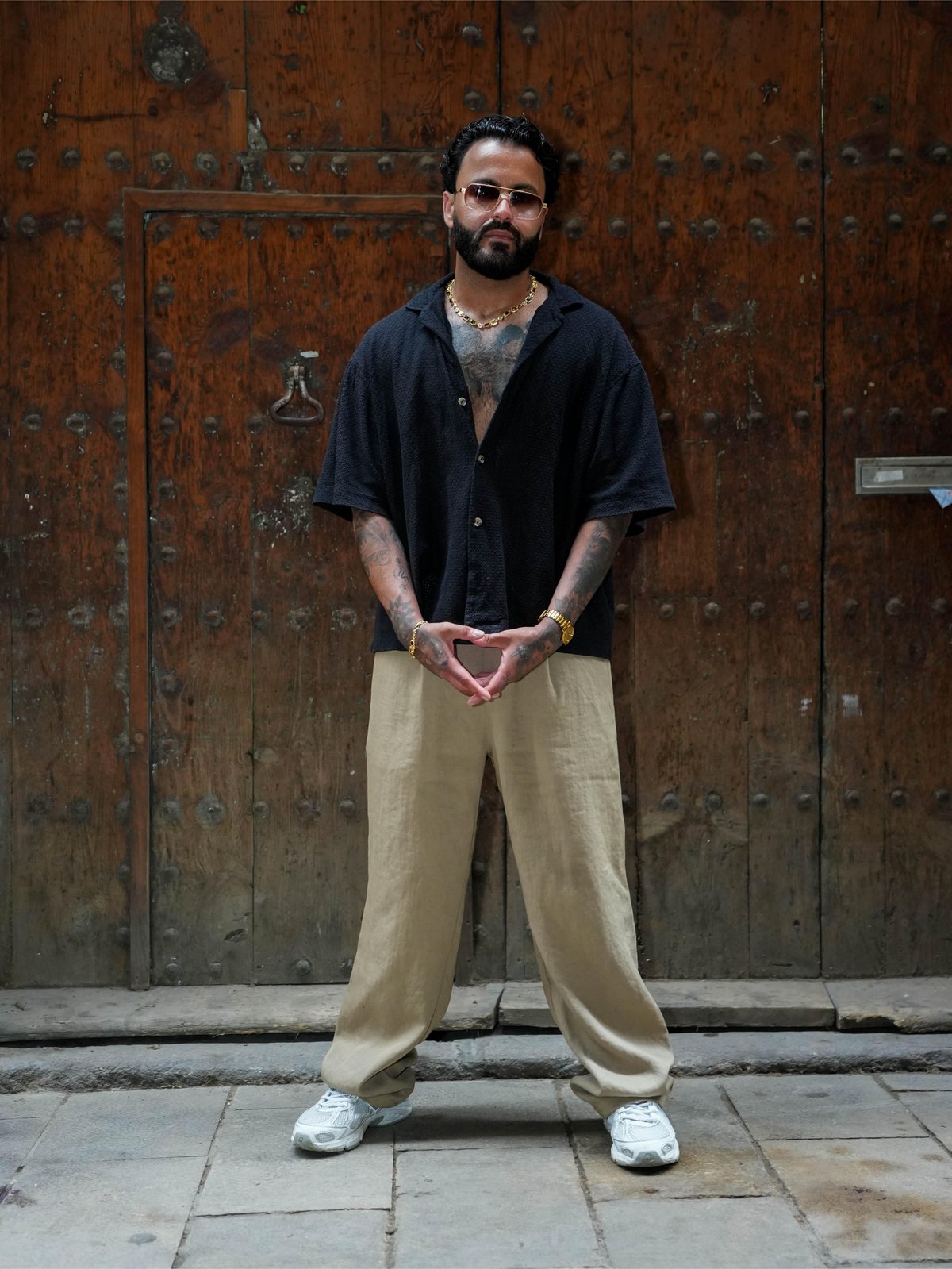
Filmed outside the O2 in London, over a quick coffee, hours before showtime. Lightly edited for readability from the spoken original; names corrected. The film will be embedded here when it goes live.
JJ: People see success, but they don't see what it actually takes to get there. Today I'm sitting down with the world-famous international stylist Javed Sheikh — straight from Mumbai, now working with Badshah here at the O2. This story is not just about success. It's about what it's taken to become the person he is today. So let's start from the beginning. Javed — who is Javed Sheikh, for the people that don't know?
Javed: First of all, that's a very good intro. Thank you so much — I paid for this. [laughs] Javed Sheikh is just a guy who cuts hair. Who fulfils the demands of his clients and makes them look good. They're all good — I make them a little bit better. I'm a hair stylist from Bollywood, from Mumbai, and I'm enjoying my work. That's it.
JJ: But you're not from Mumbai, right? Where are you from — what was it like growing up?
Javed: I'm from Punjab. A very small town called Samana, near Patiala. My father was in the same industry, so in the early days I worked with my father. He was my teacher — my first guru. After two or three years working in the salon, I took it on as a full career. I didn't start out thinking "I want to be a barber." It was a time-pass for me. But when the appreciation started coming from clients — "you're doing so good, man, everyone recognises you" — that early appreciation is what made it serious.
JJ: Before it got serious — what did you want to do?
Javed: I don't know. I wasn't aware of what I wanted. I was doing it for pocket money. Whenever I went to the salon my father gave me ten bucks, twenty bucks. That's why I went. [laughs]
JJ: I think that matters, because — like we were saying over coffee — people see the glamorous side of your life now. They don't see where it started. The struggles. The journey.
Javed: That's the reality of the world, bro. Everyone sees the glamorous part; no one sees the struggle. Nobody sees the bruised leg from yesterday. Even the artists I work with — they all have bad days, low days, bad experiences. But nobody knows, because everyone just sees: "oh my god, he's living this life, he's travelling here, he's got this and that." If you're looking at the glamorous part, you should also know the conditions — where you're working, who you're working with, what it actually takes.
JJ: Talking about conditions — you shifted to Mumbai. Did you go into a salon, or straight into the industry?
Javed: I was running my own salon in Punjab, and I got an opportunity — an academy wanted me as faculty in Mumbai. So I took it as a six-month trial. I wanted to experience Mumbai. I worked there, met people, made connections. And then, to be very frank, it was like an audition for me to get into Bollywood. I went to so many make-up artists, so many hair stylists. I contacted them, I told them: sir, please give me a chance. I just want to prove myself. Just look at my work. If you like it, call me. Otherwise I'm not charging anything — I don't want money. Just call and see my work.
JJ: That environment shaped who you are today. And people don't see the amount of free work behind the scenes.
Javed: It's not free work — this is what I explain to people. It's your investment. You're investing yourself, to become yourself. You're not wasting your money or your time. You're investing yourself.
JJ: Moving to Mumbai, proving yourself — there must have been a time you thought: have I made the right decision leaving Punjab?
Javed: It never comes because of the work. It comes when you see your family. I don't want to sound like a superhero, but work never made me want to give up — it's the external pressures. In Mumbai, whether I was working or not working, struggling or not struggling, I always enjoyed my days, because in the beginning I was only focused on proving myself. Nothing else mattered. I never saw my struggle as struggle. I was studying — studying the industry, the failures, the achievements. Whenever someone appreciated me, I'd think: now he'll call me again.
JJ: Was there ever a day on set where you gave a hundred per cent — but you knew it wasn't your day, and the client didn't like it? What did that feel like, and what did you learn?
Javed: I knew it that night. I was shooting an ad in Mumbai — I won't name the celebrity. [laughs] I went blank that day. My hands weren't working. My mind wasn't working. I don't know what happened to me. It was the black day of my life. And it was just one day — but I knew: it's not my day, I've ruined it, and he's never going to call me again. He was explaining what he wanted, I was trying, and it just wasn't happening. In the end I gave up. I told him: sir, I don't think I can do this today. It's not my day. I'm sorry for the inconvenience, I won't charge anything — but I'm sorry.
One thing I learned that day: be confident. I went too deep into my own guilt trip. But from that day I took a decision — I will never give up again. That was the first and last time. Whether I'm doing well or doing badly, my confidence stays at the next level.
JJ: That's the part people don't see — that we have failures too. So many bad days. People only see the good. Did you ever get to work with that person again?
Javed: No. Never. I think he blocked me. [laughs] He'd called me a hundred times, and the one day I went, I messed it up. But he was very sweet about it — he wasn't yelling, he wasn't complaining. He understood it wasn't my day. He did his own hair. But yes — first and last day with him.
JJ: I've had the same with a very big artist — someone I'd always wanted to work with. A phone call half an hour before, I was in town, I took it, and I just wasn't prepared. I've never worked with that person again either.
JJ: Going deeper — not just work. What's been one of the lowest points of your journey, and how did you overcome it?
Javed: Work-wise I had a full set-up in Punjab. My own salon, running well, earning good money — not huge, but comfortable. So leaving was a big decision for my family. My mother said no. "I will not give you a single penny. You go, you make it or you break it." She was crying — "why are you going to Mumbai, you have a salon here." I'd always given all my money to my mum, so I asked her: mum, I need money to book my ticket. She said no. Then she said: "I'll give you lakhs of rupees for a bigger salon — but you stay in Punjab." She'd give me lakhs to stay, and not ten thousand for the ticket. [laughs] That was a low moment. But somewhere I knew: if I step out, I will do something. In my mind I wasn't fully confident — but I knew one thing. If I go, I will do something. Big or small, I will do good.
JJ: And now they've seen it. When did your mum understand — when did you feel proud, like: mum, I've achieved this?
Javed: When my work started showing up — "this is coming out, these are the videos, these are the artists I'm working with." And when the relatives started coming to my mum saying "your son is doing very well — please ask him to introduce us to this celebrity, that celebrity." That's when a mother realises: my son did something. And I was like — yeah. Swag. [laughs]
JJ: Talk to me about the first time you worked with Badshah. The first Indian rapper to take over the whole of the O2 — and you're the first India-based stylist supporting an Indian rapper at the O2.
Javed: He's big for me — till now. I've worked with so many artists, and they're all good. I simply want to thank God, my family, and all my well-wishers, because I'm doing well and somewhere I know I'm blessed. I know my work — but I'm blessed, I'll be frank about that.
The first time I worked with him, there's a story. He used to keep very short hair, but he'd been travelling a lot, so it had grown out and he hadn't had time to cut it. When I arrived, he said "cut it off, like this and this." And I suggested: if you allow me, we can do something a little different from the regular styling. He said, okay — do it. I did it, and he loved it. "Wow, this is so nice." Then he called his manager and said: get his number — he'll be my permanent stylist for Mumbai. And from Mumbai it grew.
JJ: How did the call even reach you that first time?
Javed: Through a chain. The make-up artist who worked with him called someone, who was busy, who called someone, who was busy, who called someone — who called me. I was the fourth in the loop. [laughs]
JJ: Did you believe it when they told you? Were you confident?
Javed: The whole day I was preparing. Cleaning my kit, preparing myself, studying his photos. If his hair is long, what will I do? If it's short, what will I do? What can I do with the beard? What suggestions can I give him? The whole day, only that. So when I went, I had many things prepared in my mind. That's the important part — if I'd gone in randomly, I don't think I could have given him that level.
JJ: So it went Mumbai — then pan-India — then international.
Javed: Yes. This is my third time in London, plus two US tours. We've gone across the world, bro. London Fashion Week. Paris Fashion Week — we switched up the look for Paris. Too much, bro. [laughs]
JJ: Along the journey you've mentioned your father as your first guru. Who else — directly or indirectly — helped make you who you are?
Javed: I always study all the hair artists. I don't rank them big or small — I'm always looking for good work, always checking how it's done. There are so many Indian artists who are really good. Jawed Habib sir — I did my course at Jawed Habib. If you want to learn the basics of hair, he was the OG. The public can say anything, but in my opinion, if you want your foundations clear, Jawed Habib is the best. Your basics are your foundation, and you can get a good foundation from his academy. And Aalim Hakim — he's one of the pioneers in Bollywood who brought hair forward at a media level — TV, film, sport. He glamourised it.
JJ: I'd say Aalim's given stylists worldwide a lot more respect — especially from India. He put India on the map: you have to respect stylists.
Javed: Jawed sir and Aalim sir — they're always the OGs for me.
JJ: What does it feel like working at this level now, compared to your salon in Punjab? What's the key difference?
Javed: Honestly? As a stylist, I don't treat them differently. The artist is a priority for me, of course — but if I have a normal guy in my chair, he's the one I'm working with, and I have to make him the best. It's not that celebrity work is different. Whoever is in my chair is the celebrity for me. That's my job.
JJ: And with Badshah and the team — is there a barrier, or does it feel like family?
Javed: These aren't things you talk about all the time — but we know, somewhere. I respect him a lot, and he understands us, and that's a big thing. First of all, he's a great mentor. You can learn small things from him every single day. He's so focused. He has vision — so many visions in his mind. He knows what he wants to do and what he doesn't. The whole team learns from him.
JJ: And you can implement that beyond show business — in your personal life, your craft, your team. Talk less, do more. Let your work do the talking.
JJ: What separates the people who make it from the people who don't?
Javed: Mindset. And vision. If you're happy with small things — be happy. But if you have a vision, you have to go. Vision and hunger. And that comes with struggle. I was very comfortable in Punjab, but I left, because I knew my work could take me to better places. I'm not saying I'm the greatest — but I knew my thing.
JJ: Three pieces of advice for anybody watching who wants to reach the level you're at.
Javed: First — work on your craft. You have to be good. Connections can take you somewhere once or twice, but you can't stay there. If you want to stay, the craft has to hold you there. Second — never stop learning. It's not that you finish a course and that's the end. Keep the learning mindset. And third — be loyal to your artists. Loyalty matters so much.
JJ: Conversations like this matter, because people only see the end result — not the journey or the struggles behind it. You're the perfect example: if you're willing to work, you're hungry, and you have vision, you'll push through. Commit to the process and the outcome will come. To get to the top is easy — to stay there is the difference. Absolute pleasure, brother.
Javed: Thank you, bro. And you're travelling more than me now. [laughs]
Find out which stage is holding you back
The Global Stylist Scorecard scores you across the eight stages of the GSB Ascension Method and names the one costing you bookings. Twelve minutes. No email, nothing to buy.
Take the Scorecard