Vin Lakhatariya: born into barbering
He picked up the clippers at eleven in his father's Leicester shop — the latest in generations of family barbers — and was told by the man who taught him that there was no career left in the trade. JJ sits down with Vin Lakhatariya of Roots & Co in Malta, at half eleven at night after a full day of teaching, to trace the road from £5 cuts on Belgrave Road to main stages across the UK, Europe and India — and a five-year working partnership without a single fallout.
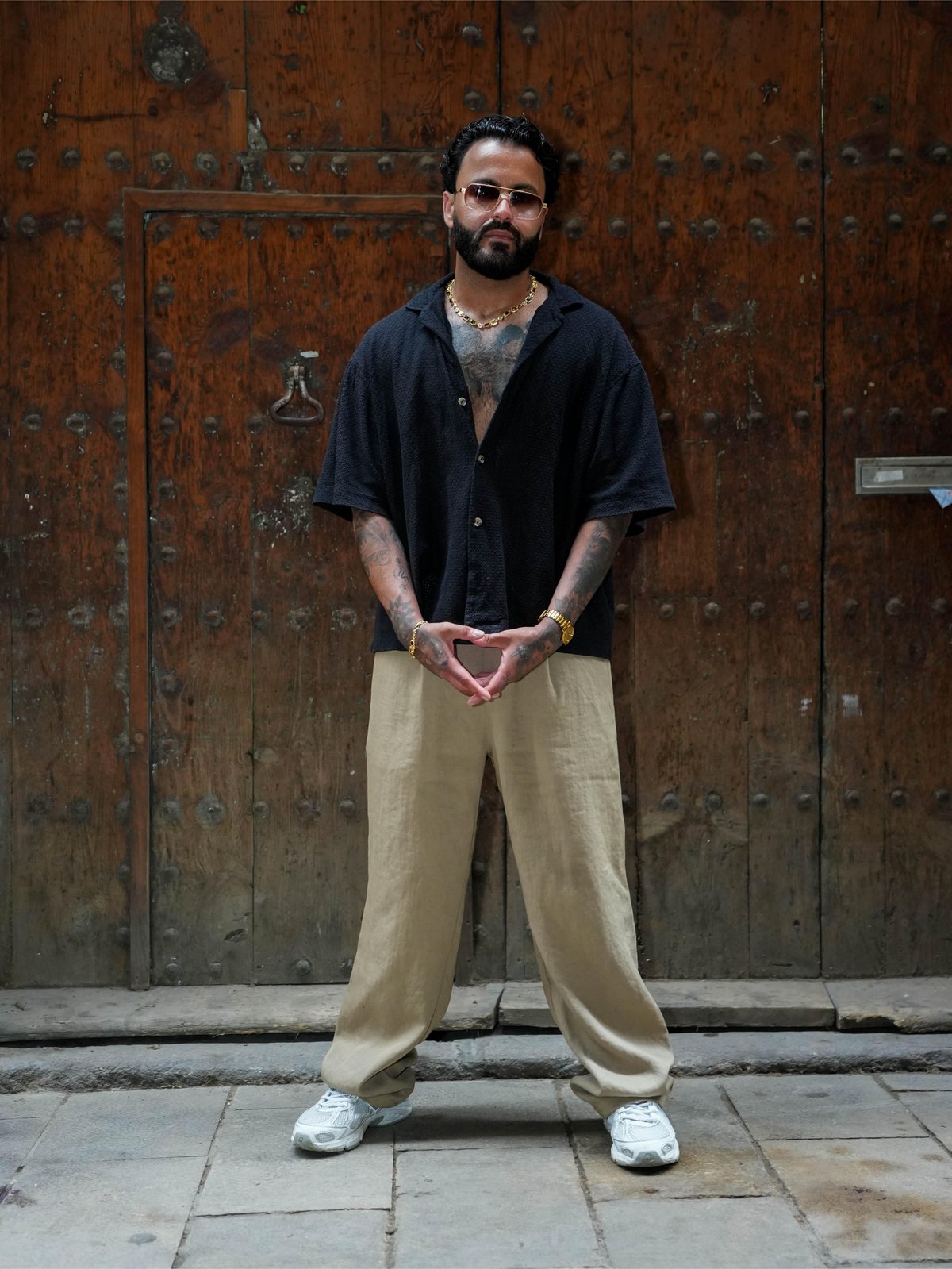
Episode two of Global Stylist Stories, filmed in Malta at 11.30pm after a full day of teaching — JJ on one hour's sleep before a morning flight. Lightly edited for readability from the spoken original; names corrected.
JJ: Episode two of Global Stylist Stories. Some people in life choose barbering — some of us are born into it. The real decision is what you do with it. Today I'm with Vin Lakhatariya of Roots & Co. Vin — start from the beginning. Who is Vin, for the people that don't know you?
Vin: Born and raised in Leicester. My roots come from India — my father was born there, my mum's from Kenya. And it started with my father. I was eleven years old when I picked up the clippers. Dad said: right, here you go — you've been watching me for a couple of weeks. Call your best mate in and start cutting his hair.
JJ: How was that first trim?
Vin: It took me an hour and forty-five minutes to do a skin fade on the side. My first ever cut — skin fade, number three on top, for my best friend Sundeep. I still cut his hair to this day. I had no idea how to start it. All my dad said was: don't worry, I'm here if you need my guidance — but you do it, to the best of your ability. And at the finish I thought, that's a wicked cut. Looking back at it — no, it wasn't. [laughs] But that's how you live and learn.
JJ: And honestly, I was a lazy kid at that age. My dad came in one day and said: if you want to do something in life, you'd better get up — come to the shop. I went with him on the Saturday, and that was the last of the lie-ins.
JJ: Let's go deeper, because like me you come from a Gujarati background — and historically, in the caste system, your caste defines your trade. Ours is the barbering caste. Growing up, how did that feel? Did it feel like you had no choice — or did you want it?
Vin: Honestly? I was proud. I was very proud that we were barbers — because of the creativity, and because of the people. You'd have everyone from schoolkids to old-age pensioners walking through that shop — different backgrounds, different religions, different ages — talking to you about life. That was a massive learning curve. I was proud to be born and bred into it.
JJ: That's powerful — a lot of barbers choose this; you were born into the identity. And it goes back generations: your dad, your dad's dad, his dad before him. Your brother too — I trained him at the London apartment. And a funny thing most people don't know: before I ever met Vin, I used to get my haircuts from his dad in Leicester, as a kid, with my twin brothers and my father. We only worked it out three years ago — his dad recognised me.
JJ: A whole generation above you in the trade. Was there pressure — am I good enough, will I live up to the family name?
Vin: No pressure — and I'll tell you why. I loved it so much I never looked at it as a job. It was a hobby that became my passion, and then you start earning from it. What I really enjoyed was the conversation — understanding the client, building relationships over weeks and years. It's scary now: I'm cutting friends whose kids are growing up in my chair. But there was never "I'm going to let the family down." The moment I picked up the clippers and watched my dad, I knew: this is who I want to be.
JJ: And I see it in what you've built at Roots & Co — you're moulding your team the way your dad moulded you. I've watched Mohit's development from when he started with you to now: phenomenal levels. One of the best in Leicester, and I'll happily say that openly.
Vin: A hundred per cent. When Mohit came to the shop he had about a year's experience, and he actually said to me: Vin, I don't feel like I'm good enough to be in this shop. And I said — whoa. Hold on. Never say that. Never downgrade yourself; we all learn from somewhere. There's no ego in our shop. What I say to anyone who walks in wanting to become a barber: run this business as if it's your own. You're not working for me — we're working together. We are the pillars of the business.
JJ: That's the mindset that separates long-term success from short-term. If you want to go fast, go alone; if you want to go far — you're only as strong as your team. And it shows: three years ago there were three or four names in Leicester people wanted to work for. Now it's "check the Roots & Co page — have they got vacancies?"
Vin: I was going to put an ad out, and Mohit and Rohan both came organically — they approached us. When someone has the passion and the drive, I see myself in them. Rohan only graduated in barbering last June, started with us in October, hadn't been cutting in between. I told him straight: you may not get booked up — it may take a year to build even a few clients a week. But I promise you one thing: put the hard work in and you'll get your clientele, and you'll get the repeat customer. Retaining your customers is everything.
JJ: Exactly what we taught in today's session: getting clients is easy — retaining them is your bread and butter, your reputation, your legacy. And it's the hardest part.
JJ: Let's talk struggles. From the family expectation, to being the trainee nobody wanted to sit with, to opening your own place. Be as raw as you like.
Vin: I started at my dad's shop every Saturday while I was still at college. And I remember my father saying to me: "There is no career left in barbering." That really hit me. You have to remember — this was the early 2000s. Five-pound haircuts. There was a shop round the corner charging three pounds fifty. Barbering wasn't glamorous then — it was looked down on. The end goal, the whole dream, was: open a shop, have some barbers working for you, fifty-fifty on the chairs. That was it. So being told by my biggest inspiration — a barber from generations of barbers — that there was no career in it? I was stunned.
JJ: And Leicester still has five-pound barbershops. What are you charging now?
Vin: Twenty-five to thirty. There are brands charging more, but we know the market we're targeting. An average barber now is eighteen to twenty-two.
JJ: So how did you deal with what your dad said?
Vin: I still studied. I did product design — went to uni, got my BA. And it absolutely helped, because the way I looked at it was: I want to make and build things for the barbering industry. I've done wireless-charging products, I learned manufacturing and materials, I've made prototypes I'm still working on in the background. If you want to be behind the chair, amazing — nothing wrong with that. I just felt I had more to give than cutting hair alone.
Vin: After uni I got a graduate placement — unpaid, in Oxford, accommodation covered. So the first day I landed, I looked up every barbershop in Oxford and approached the best one. On my weekends I'd cut — and I made sure four days of cutting in a month covered a UK minimum salary. That money I reinvested in myself. Then another opportunity knocked: come to Dubai.
JJ: And here's the part people won't expect — that wasn't barbering either.
Vin: No. It was a business-partner opportunity in construction — maintenance and renovation. An industry I'd never touched. But I had product design and an eye for interiors, so I plugged the two together and brought UK standards to Dubai, which the market was missing. We grew from four people to many times that within a year. And I did the same thing I'd done in Oxford: found the best barbershop in Dubai — Chaps & Co, one of the best chains, still going — and cut there. That opened my eyes. From five-pound cuts on Belgrave Road to fifty-pound services, clients back every four or five days, fifteen to eighteen clients a day, five of us in the shop, seven days a week.
JJ: This is why these talks matter. People see you on stage across India, leading fashion weeks, out here in Malta — they don't see the juggling. I didn't know half of this until today. They just thought: he's a barber.
JJ: When did things change — when did you start wanting more than the shop?
Vin: My dad inspired that too. Back in the day he did shows — not trade shows: celebrities. Actors and singers used to come through Leicester, and dad cut their hair out of the shop. I stepped in once and saw this wall of photographs — all the old Bollywood names. And I thought: I want to be in that position. Not so I can say I cut a celebrity's hair — because I love the craft, and I want my trademark on the highest-profile heads there are, and let the skill speak worldwide for itself.
JJ: We started working together in 2021 — Salon International that September. Five years now. What changed in your mindset?
Vin: Where we could take it together. We've picked each other's brains constantly — and honestly, more ideas have come from hotel rooms, dinners after shows, than the stages themselves. Look at right now: it's half eleven at night. You landed this morning, we've delivered non-stop training, dinner with clients, and now we're filming this — on one hour of sleep before you fly out.
JJ: It's the work rate and the hunger — and it's not really me mentoring you any more; we mentor each other. Which raises the thing people always ask: two salon owners, five years, separate brands — no conflict? Find me two people from two separate businesses in this industry who've worked together five years with no fallout. It doesn't happen — there's always jealousy, rumours, external pressure. With us, if either of us hears something, we call each other directly. We even swap clients — I sent a uni student in your city to you two weeks ago rather than have him travel to me.
Vin: And for the people who don't want to believe there's no beef — check the stories. We were at a friend's engagement party ten days ago. We've just been busy building.
JJ: Education-wise, you're where a lot of stylists want to be: main stage UK, Europe, India — not in front of five people, in front of crowds at Professional Beauty shows in the tens of thousands. Compare that first Modern Barber stage with me in London to India.
Vin: The first Modern Barber stage — do you remember? Three, maybe four people sitting at the front. And in my head: it's a start. No one knew me. But here's what I'd learned: if you talk and deliver on stage the way you talk in the shop, you'll be fine. You don't need to portray someone else.
JJ: And I'll say this openly, because I got stick for it at the time — "JJ, why are you putting people on stage with no stage experience?" Because I struggled in this industry for over a decade and nobody gave me a chance. If I can help somebody who's hungry and wants it as much as I did — why not? That's how the industry moves forward. And you're one of the only people I've worked with where it just flowed — no prompting, no awkward pauses. One of the best gambles I've ever taken. Being technically brilliant is one thing; being technically brilliant on stage is a different ball game.
Vin: And then India. Surreal — because it was taking my roots back to my roots. Going back home, and being appreciated for how you work, by people who genuinely wanted to learn. When you and I started, barbering was looked down on — and in India it still is, though it's changing fast; the barbers there now would give the UK competition. But to stand on that stage and have people think "we could be like JJ and Vin one day" — that's the wake-up call. They've got the passion. They just haven't been shown how the industry works. And we've got a lot to give them — that's in the making.
JJ: Bring it home. Roots & Co — the name.
Vin: That name mattered to me because of the years behind it. I didn't want "something-something barbershop." It was lockdown, I was brainstorming, and I asked myself: what can I call it that takes me back to my roots? It was literally the first word I wrote down — and the way I wrote it that day is the logo you see now. Simple, original, powerful. Everything from your ancestral heritage to your own roots in the family — and it's a big part of how we train, teach and treat the clientele.
JJ: Every time I walk in, it isn't stepping into a barbershop — it's stepping into a home. The chairs are even set so conversations open up across the shop. You'll spin two clients round to talk to each other.
Vin: Nine times out of ten, everyone leaves having had a great time. And you learn to read the one who just wants to chill. [laughs]
JJ: So we've come full circle. Learning at your dad's chair, opening your own shop, the stages, the fashion work — and now you're in Malta, leading a fashion shoot and officially mentoring others on The Global Stylist Blueprint. How does that feel?
Vin: Honestly — I never envisioned this side of it. What I've said to myself and to others: nothing is impossible. It feels like I've accomplished something that was always meant to be there — what my dad taught me, I'm now passing on. It's literally a whole circle. And it's mind-blowing, because you are your own limit.
JJ: At a certain point the journey stops being about your success and becomes about the impact you leave on others. The feedback from today's students — you changed mindsets. And yes, we made one of them redo a look, because we're not here to sugar-coat; we're not setting people up to fail in the real world.
JJ: Final message for anyone watching?
Vin: If you're genuinely passionate about this industry and you want more than the shop you're standing in — step out of your comfort zone. It puts the spark back into you. You won't lose your barbering; your clientele will be there as much as you want it to be. But if you're looking for what's outside the norm, there's a huge opportunity out there — and honestly, this Global Stylist programme JJ's built is a must-do.
JJ: Shameless sales aside — what's next for Vin and Roots & Co?
Vin: 2.0.
JJ: Going to elaborate?
Vin: Nah. [laughs]
JJ: Roots & Co 2.0 — incoming. You heard it here.
Find out which stage is holding you back
The Global Stylist Scorecard scores you across the eight stages of the GSB Ascension Method and names the one costing you bookings. Twelve minutes. No email, nothing to buy.
Take the Scorecard